
Game Mechanic: Tile Placement
4 games with this mechanic
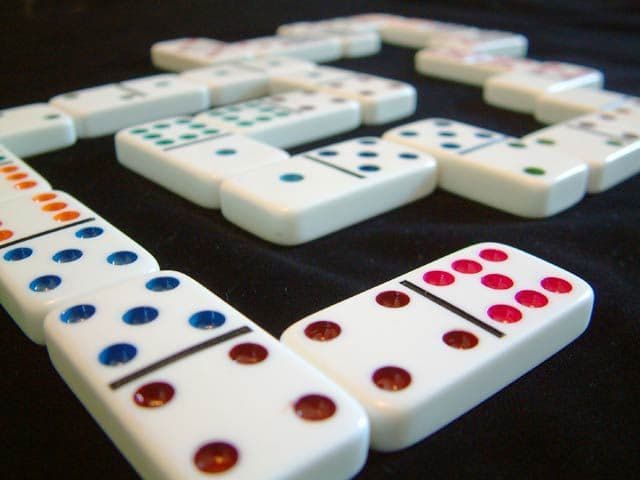
Dominoes double six
A traditional tile game played in many different cultures around the world. This entry is for Western Dominoes; the standard set being the 28 "Double Six" tiles. Chinese Dominoes use a 32 tile set with different distributions. Dominoes is a family of games using the "Western" style tiles. The standard set of tiles is based on the 21 different combinations made with a roll of two six-sided dice. Seven (7) additional "Blank" combination tiles combine with the 21 to form the standard 28 "Double-Six" set. "Double-Nine" (with 55 tiles) and "Double-Twelve" (with 91 tiles) are also popular. "Double-Fifteen" sets with 136 tiles also exist. There are many different games played with Dominoes. The standard game is known as the Block game. Forms of this game are known in many different areas of the world with similar rules. Puerto Rican Dominoes, Latin Dominoes, and Cuban Dominoes are all forms of the Block game. Another main variety of Dominoes games are based on the "Fives Family". Five-up, All Fives, Sniff, and Muggins are all part of this family. This variation adds the ends of the dominoes to make a multiple of five for scoring. Other popular Dominoes games include 42, ChickenFoot, and Mexican Train.
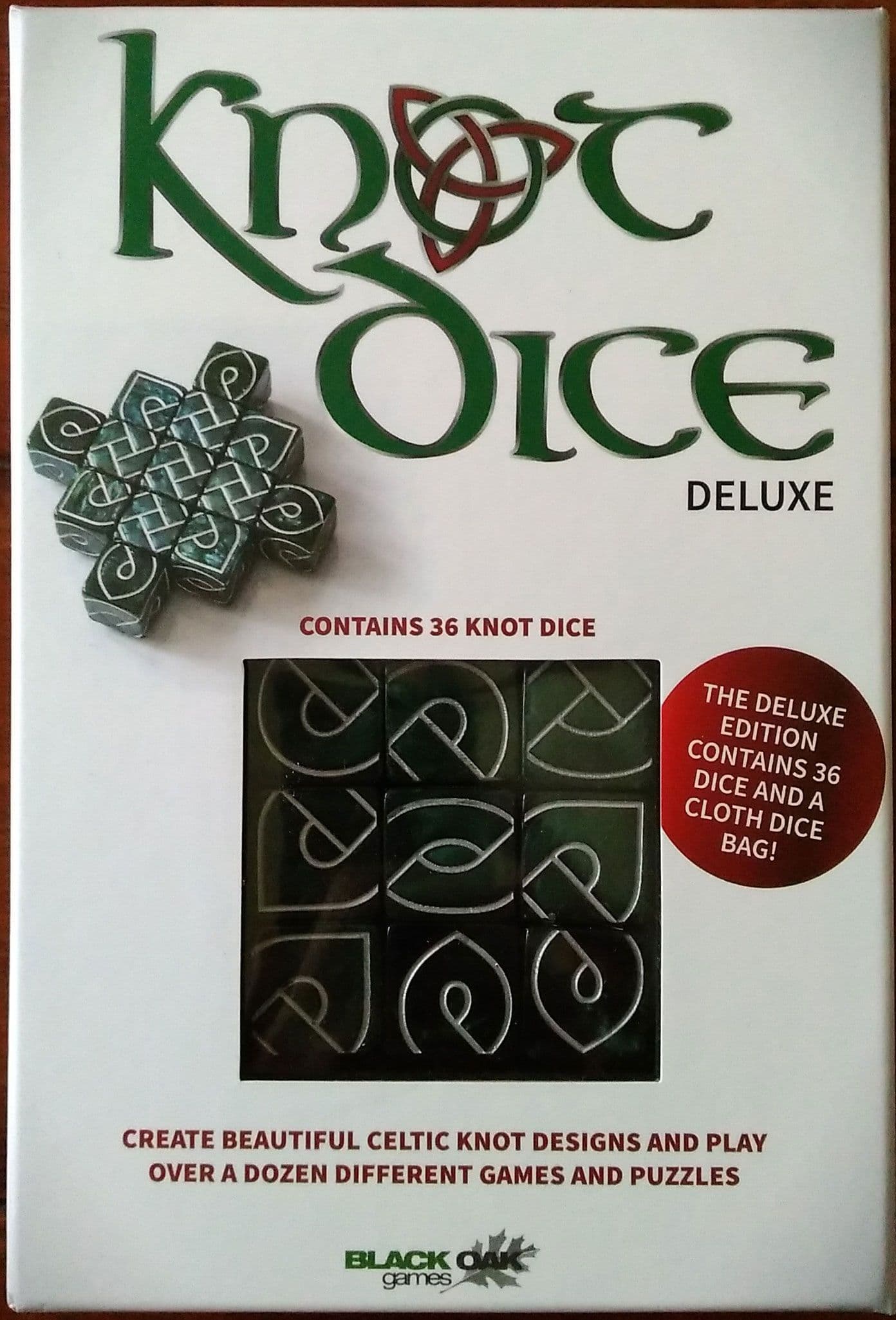
Knot Dice
Knot Dice is games, puzzles, and art wrapped up in a box. The 18 custom dice have Celtic knots design elements on each side that can be connected to play various games and create a large number of designs. Included are rules for several games and puzzles, including: Kells – a cooperative game for 1-3 players (or more with more sets), in which you try to form a complete design using as many dice as possible Kells, The Book – a campaign version of Kells Knot So Fast – a competitive real-time game for 2 players (or more with more sets), in which you try to form a closed design with your dice as quickly as possible Knot So Fast Too – a round-robin tournament real-time game for 3-4 players Distance – a competitive game for 2 players, in which you move two tokens over the paths created on the top of the dice to get your tokens farthest from one another Osbox (by Cameron Browne) – a 2-player pure strategy game, in which you select the face of a die to use and slide it on to a 4x4 grid trying to complete designs
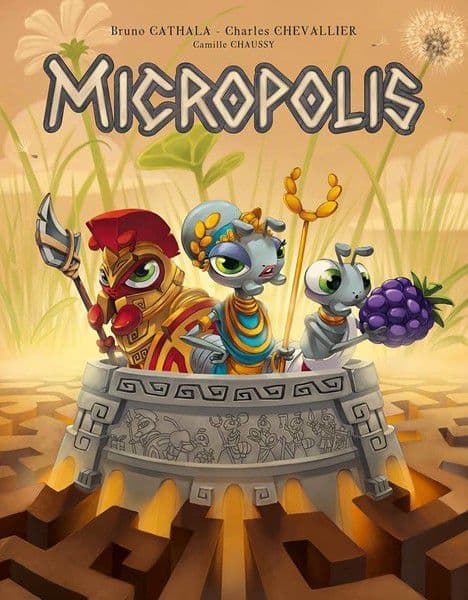
Micropolis
Gather your ants in Micropolis, and send them through the anthill to do your bidding. What do you want? Fruit? Warriors? A queen? Even more ants?! Each player starts with a central location that will be surrounded by ten tiles over the course of the game, with the tiles being connected by a series of tunnels. Over ten rounds, players draft tiles one at a time, with the player with the largest army going first. They can take the first tile in line, or place an ant on each tile they want to pass to get to something better. The tiles have various roles on them: Queens who if alone can improve their space; Nannies who give you extra ant soldiers; Architects who let you take any tile for free; Warriors who attack the first player; Generals who manage the movement of your ant soldiers; and Fruit gatherers who collect fruits, which score based on the variety you have. Ants at the end of the game are worth one point each, and whoever has the largest army earns an additional 5 points.
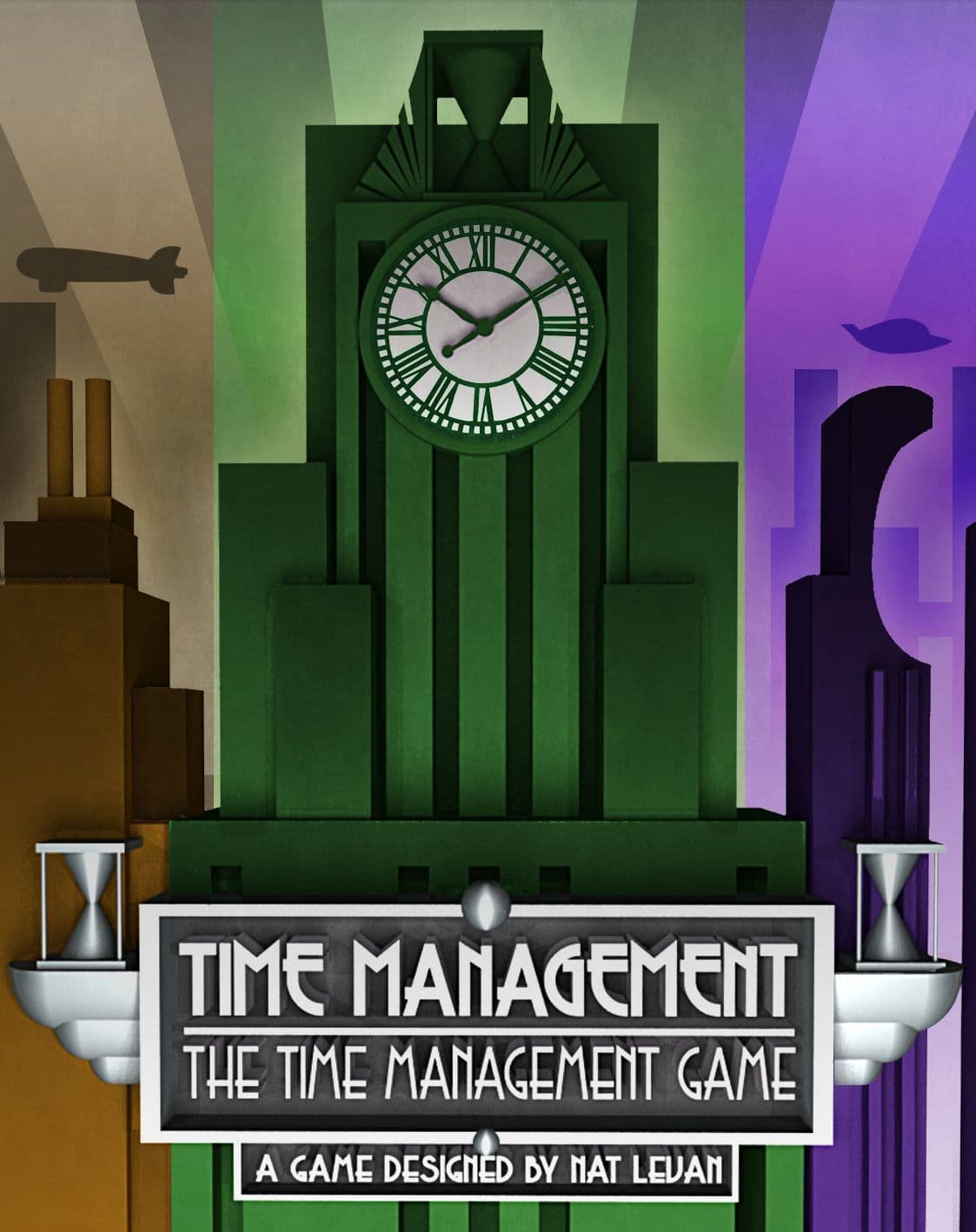
Time Management: The Time Management Game
Time Management: The Time Management Game is a quick-playing, tile-laying game. Players are workers at the Office of Time Management, managing the space-time continuum. Their goal is to add temporal workers to the work force and arrange them in such a way to ensure the safety of the continuum and to save time — and save time!